Quick Answer
Is granite or marble better for residential flooring?
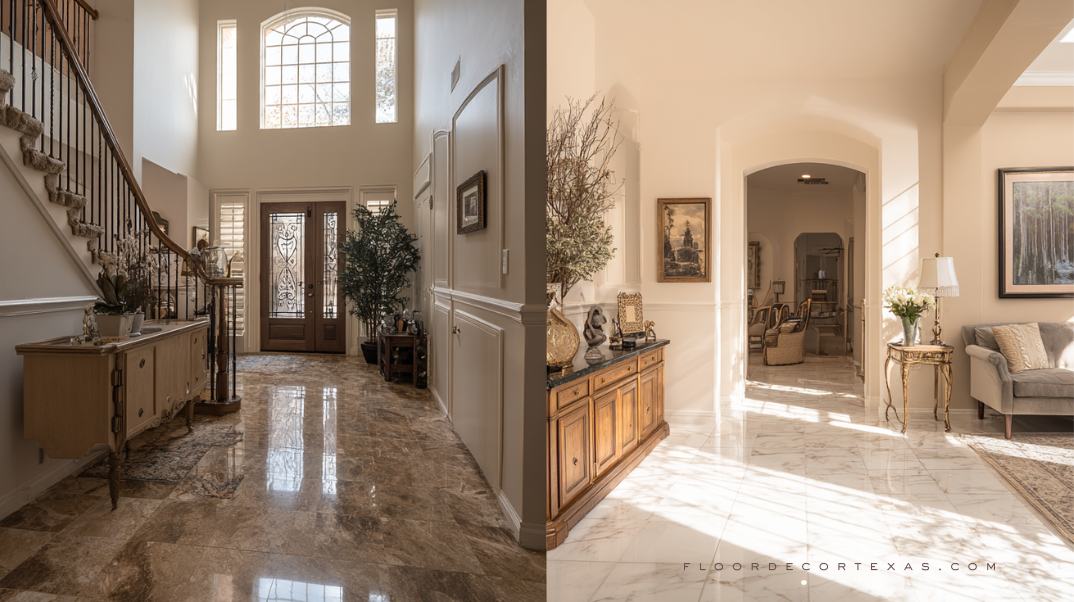
Granite is generally the stronger candidate for demanding traffic because many granites offer high abrasion resistance and low absorption. Marble provides distinctive veining but is vulnerable to acid etching and visible finish wear. The correct choice still depends on test data for the exact stone, finish, room, substrate, slip requirements, and maintenance plan.
Granite vs Marble Flooring for Texas Homes

The granite versus marble decision should not begin with the assumption that one stone is always superior. Both names cover natural products with variations in mineral composition, absorption, abrasion resistance, strength, color, finish, and fabrication quality. A polished showroom sample cannot answer every performance question.
Granite is an igneous stone group commonly selected for heavily used surfaces. Many granites offer low absorption and strong abrasion resistance. However, products marketed as granite can differ, and a broad category name is not a replacement for current test data from the supplier.
Marble is a metamorphic, calcium-based stone valued for veining, depth, and finish options. Its calcium carbonate content makes it vulnerable to acids. Vinegar, citrus, wine, tomato products, and acidic cleaners can etch the surface. A suitable impregnating treatment may improve stain resistance, but it cannot prevent this chemical reaction.
Texas houses are built over diverse soil and foundation conditions. The state includes sandy, rocky, shallow, and heavy clay soils. Soil type alone does not determine whether a stone floor will fail. The foundation, supporting structure, substrate, joints, moisture, installation method, and movement accommodation must be evaluated for the actual property.
Homeowners should also compare other tile flooring options, review the guide to high-traffic flooring for Texas homes, and understand tile and stone floor care before selecting a material.
Granite vs Marble Flooring Entity Map
Natural Stone Institute
The Natural Stone Institute publishes stone standards, technical information, care guidance, and testing resources.
Tile Council of North America
The Tile Council of North America publishes installation resources covering ceramic, glass, and natural stone tile assemblies.
ASTM International
ASTM International publishes test methods and specifications used to evaluate stone absorption, strength, abrasion, and other properties.
American National Standards Institute
ANSI A326.3 provides a method and use guidance for dynamic coefficient-of-friction testing on hard-surface flooring.
Texas A&M AgriLife Extension
Texas A&M AgriLife Extension documents the diversity of Texas soils rather than treating the entire state as one clay-soil condition.
Ceramic Tile Education Foundation
The Ceramic Tile Education Foundation administers installer education and certification programs.
Granite vs Marble Flooring Performance Differences

Abrasion and traffic
Many granites provide strong abrasion resistance and are appropriate candidates for heavily used floors. That does not make every granite scratch proof. Mineral composition, finish, traffic, outdoor grit, cleaning tools, and maintenance all affect wear.
Marble can perform as flooring when selected and installed appropriately, but polished marble may show scratches, etching, and traffic lanes more visibly. A honed finish can make changes in sheen less obvious, although the word honed does not establish durability or wet slip safety.
Absorption and staining
Many commercial granites have comparatively low absorption, but suppliers should provide data for the exact stone. Low absorption reduces available pore volume; it does not make a floor immune to staining, residue, moisture problems, or damage from incompatible products.
Marble absorption varies. When suitable, an impregnating treatment can improve stain resistance. Neither granite nor marble automatically requires sealing on a universal schedule. The decision depends on the specific stone, finish, room, exposure, and treatment manufacturer instructions.
Chemical sensitivity
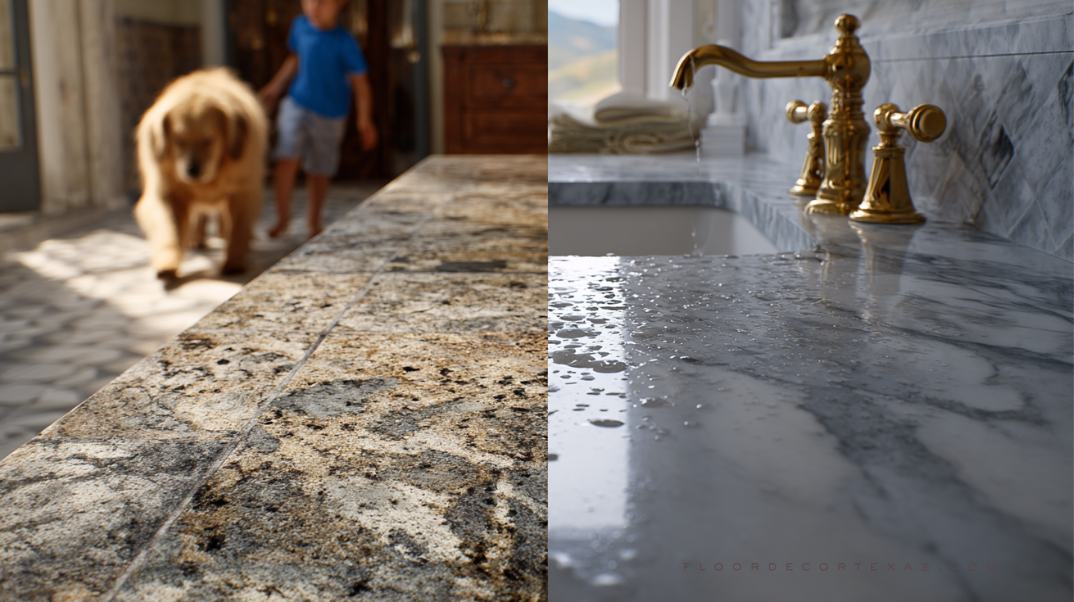
Marble reacts with common acids because it is calcium based. The resulting dull area is an etch, not a removable stain. Granite is generally more resistant to common household acids, but acidic cleaners are still a poor default because granites can contain acid-sensitive trace minerals and applied treatments.
Color, veining, and finish
Marble is often selected for flowing veins, translucent depth, and dramatic book-matched or directional layouts. Granite commonly offers granular mineral patterns and broad color variation. Both are natural materials, so several pieces should be reviewed before approval.
5 tests
Flooring evaluation may require slip, abrasion, absorption, compressive-strength, and bending-strength data for the exact stone.
Granite vs Marble Flooring Installation in Texas
Start below the visible stone
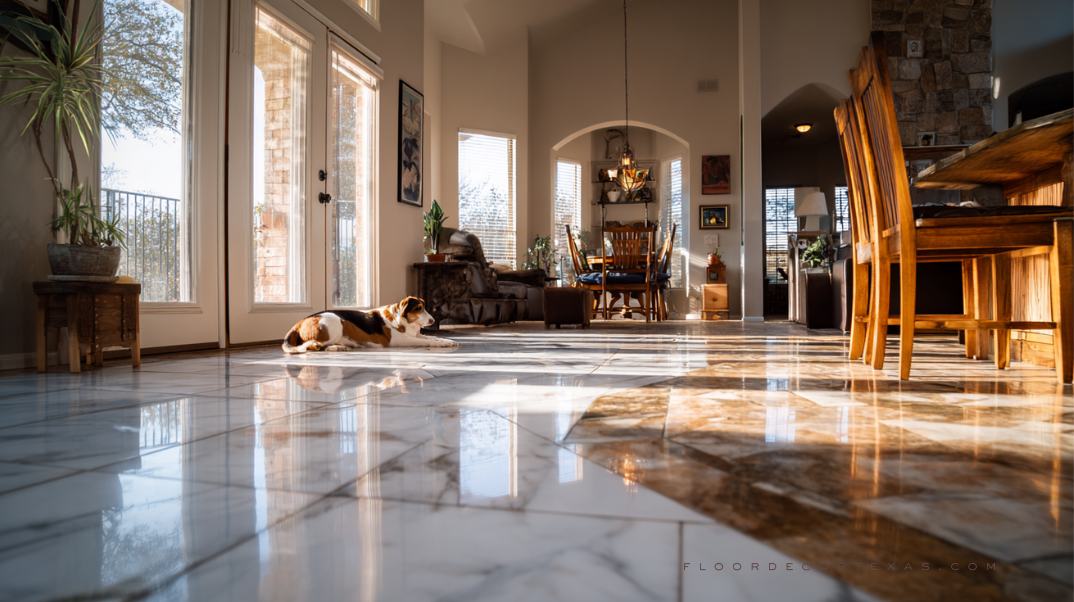
Natural stone tile requires a properly designed, constructed, and prepared supporting assembly. Foundation type, structural movement, substrate flatness, deflection, cracks, moisture, joints, contamination, and mortar coverage can influence performance.
Stone selection does not compensate for an unsuitable substrate. A stronger stone can still crack, loosen, or tent when the assembly moves or the installation method is incorrect. Existing cracks and joints require project-specific evaluation rather than a generic membrane recommendation.
Plan movement accommodation
Tile and stone installations need movement accommodation because the finish layer and supporting structure expand and contract differently. Perimeter gaps, structural joints, changes of plane, and field movement joints must be included where required.
Sunlight matters primarily when it heats part of the floor more than surrounding areas. The resulting temperature difference can increase movement demands. It does not establish a universal claim that granite is UV stable or that marble will fail in every bright room.
Evaluate wet slip performance
A polished stone can become slippery when contaminated or wet, but finish labels alone do not quantify risk. Request test information for the exact stone and finish. Also evaluate drainage, slope, joints, lighting, footwear, cleaning, and intended users.
Honed or brushed finishes may produce a different walking surface, but they are not universal safety guarantees. Field-applied treatments should be tested for appearance, measured performance, durability, and maintenance before broad use.
Hire qualified labor
Ask installers about natural-stone experience, qualifications, insurance, references, substrate evaluation, layout approval, movement joints, mortar coverage, stain prevention, protection during construction, and final maintenance instructions.
Pro Tip from the Editorial Team: Request product data and representative samples before asking which stone is better. Without the exact properties, finish, and room conditions, granite versus marble is only a visual comparison.
Build a Room-by-Room Stone Plan
Compare traffic, moisture, sunlight, maintenance, substrate conditions, and design goals before assigning stone to each room.
Granite vs Marble Flooring Cost and Room Planning
Compare complete installed scopes
Universal square-foot prices are unreliable. Material origin, grade, finish, format, lot, freight, quantity, waste, demolition, substrate preparation, setting materials, pattern, transitions, labor, access, and local availability can change the final project cost.
Request written estimates that identify what is included and which conditions could create change orders. A lower material price does not guarantee a lower project cost if one option requires greater preparation, sorting, installation time, or maintenance.
Use granite where its data supports the demand
Granite is often a strong candidate for entrances, hallways, kitchens, and busy living areas because many products offer favorable strength, abrasion, and absorption characteristics. Verify that the selected finish and product are suitable for the actual traffic and moisture exposure.
Use marble where its appearance and care fit
Marble may suit formal rooms, powder rooms, primary bathrooms, entries, or statement spaces when the household accepts acid sensitivity and visible finish changes. It can also be used in active rooms when the exact stone, finish, installation, and maintenance plan support that decision.
Avoid rules such as granite where we live and marble where we show. Households, stones, and rooms differ. A tested marble may outperform an unsuitable granite in a specific application, while another marble may be a poor match for the same location.
Plan maintenance and attic stock
Both stones need regular grit removal, compatible cleaning, prompt spill response, suitable mats, and floor protection beneath furniture. Marble requires particular caution with acidic products. Follow the Floor Decor Texas guide on cleaning marble floors without damage.
Order attic stock based on the final layout, waste calculation, natural variation, and future repair needs. Store it flat, dry, protected, and labeled with the stone name, supplier, production lot, finish, and project date.
Granite vs Marble Flooring Comparison Table
| Decision Area | Granite Flooring | Marble Flooring |
|---|---|---|
| Typical appearance | Granular mineral patterns and broad color choices | Flowing veins, crystalline depth, and broad variation |
| Abrasion | Many products offer strong abrasion resistance | Performance varies; finish wear may be more visible |
| Acid exposure | Generally more resistant, but acids are not a recommended cleaner | Calcium-based surface can etch from common acids |
| Absorption | Many granites have comparatively low absorption | Varies by stone and finish; verify test data |
| Wet-area decision | Requires finish-specific slip data and a complete wet-area assembly | Requires finish-specific slip data and a complete wet-area assembly |
| Cost | Depends on product, finish, freight, preparation, and labor | Depends on product, finish, freight, preparation, and labor |
Granite vs Marble Flooring Frequently Asked Questions
Is granite always better for high-traffic flooring?
No. Granite is often a strong candidate, but use depends on test data for the exact stone, finish, traffic, moisture, cleaning program, supporting assembly, and installation method.
Can marble flooring work in a home with pets and children?
Yes, when the household accepts marble care requirements. Remove grit, clean accidents promptly, avoid acids, use compatible mats, and select the stone and finish for the actual room.
Is honed marble safer than polished marble?
The finish name alone does not establish safety. Request wet slip-test information for the exact product and consider drainage, slope, contaminants, joints, footwear, maintenance, and intended users.
Does granite need to be sealed?
Not every granite needs a sealer. Some products may benefit from a compatible impregnating treatment. Follow supplier guidance for the exact stone, finish, room, and exposure.
Does marble flooring increase resale value?
There is no reliable universal percentage. Property condition, buyer preferences, market, installation quality, maintenance, and overall design influence resale outcomes.
Can granite and marble be used in the same home?
Yes. A mixed-stone plan can work when each exact stone and finish suits its room. Coordinate thickness, transitions, maintenance, appearance, and installation details before ordering.
Choose Granite or Marble with Better Evidence
Match verified stone properties, room conditions, installation requirements, and maintenance expectations before choosing.
- Request test data for the exact stone
- Evaluate the complete supporting assembly
- Compare complete installed project scopes
- Keep samples, attic stock, and care records
