Quick Answer
What are the best sustainable flooring options?
Bamboo, cork, and verified reclaimed wood can be sustainable flooring options, but the material name alone does not guarantee a low environmental impact. Compare responsible sourcing, manufacturing, transportation, durability, repairability, indoor-emissions testing, installation products, and end-of-life options before selecting a floor.
Sustainable Flooring Options and What Sustainability Really Means
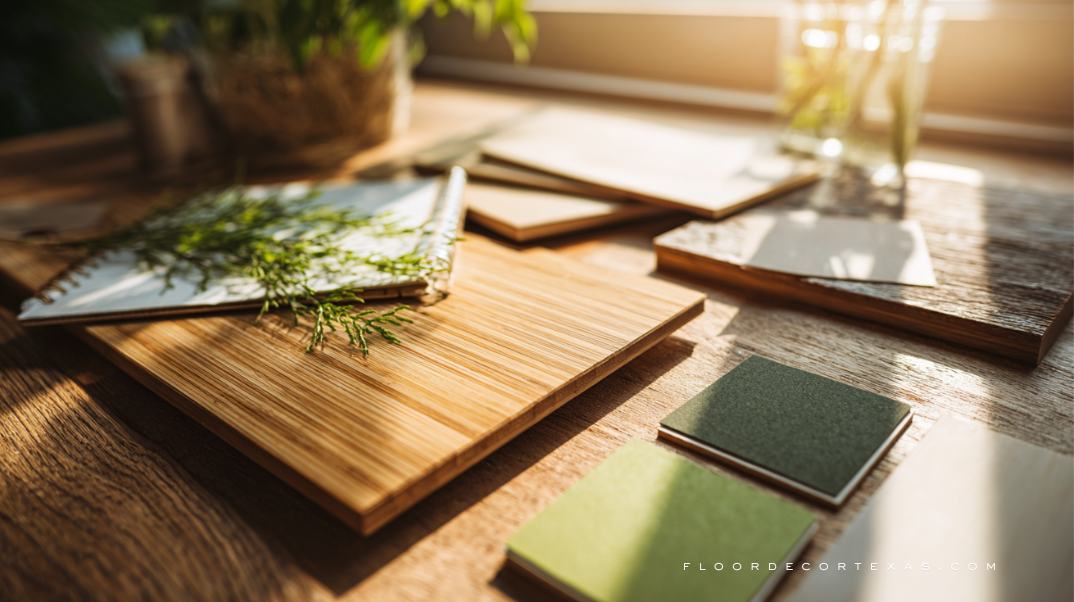
Sustainable flooring options can support a lower-impact home, but evaluating flooring requires more than identifying whether the raw material grows quickly or has been used before. A complete assessment considers where the material originated, how it was processed, how far it traveled, what adhesives and finishes it contains, how long it is expected to remain in service, and whether it can be repaired or recovered later.
The floor covering is also only one part of the installed assembly. Underlayment, adhesive, grout, finish, moisture barriers, subfloor preparation, and routine cleaning products may influence indoor air quality and the project’s environmental profile. A durable floor that remains useful for decades may avoid the material and energy demands of repeated replacement, provided it is appropriate for the room and maintained correctly.
Broad labels such as green, natural, renewable, and eco-friendly do not provide enough information for an informed comparison. Look for product-specific documentation, recognized certification, published emissions results, warranty terms, and clear maintenance instructions. Floor Decor Texas provides additional planning information in its flooring Knowledge Hub.
The six questions every shopper should ask
- Can the manufacturer document the origin of the raw material?
- Does the exact product have third-party environmental or emissions documentation?
- Will the flooring tolerate the room’s moisture, sunlight, and traffic?
- What adhesives, finishes, and cleaning products are required?
- Can damaged sections be repaired instead of replacing the entire floor?
- What disposal, reuse, or recycling options are realistically available locally?
Sustainable Flooring Options Entity Map
The following organizations provide standards, certifications, testing frameworks, or authoritative consumer information relevant to sustainable flooring options. Certification should be verified for the exact product rather than assumed from a manufacturer’s general environmental messaging.
Certification and chain-of-custody systems for forest materials, including wood, bamboo, and cork.
U.S. Environmental Protection Agency
Consumer guidance about indoor pollutants, formaldehyde, ventilation, and building materials.
Third-party certification addressing VOC emissions from hard-surface flooring and related materials.
LEED criteria covering low-emitting materials and building-product evaluation.
Environmental Product Declaration services based on life-cycle information and product-category rules.
National Wood Flooring Association
Technical and consumer guidance for wood-floor installation, care, repair, and service conditions.
Bamboo Sustainable Flooring Options
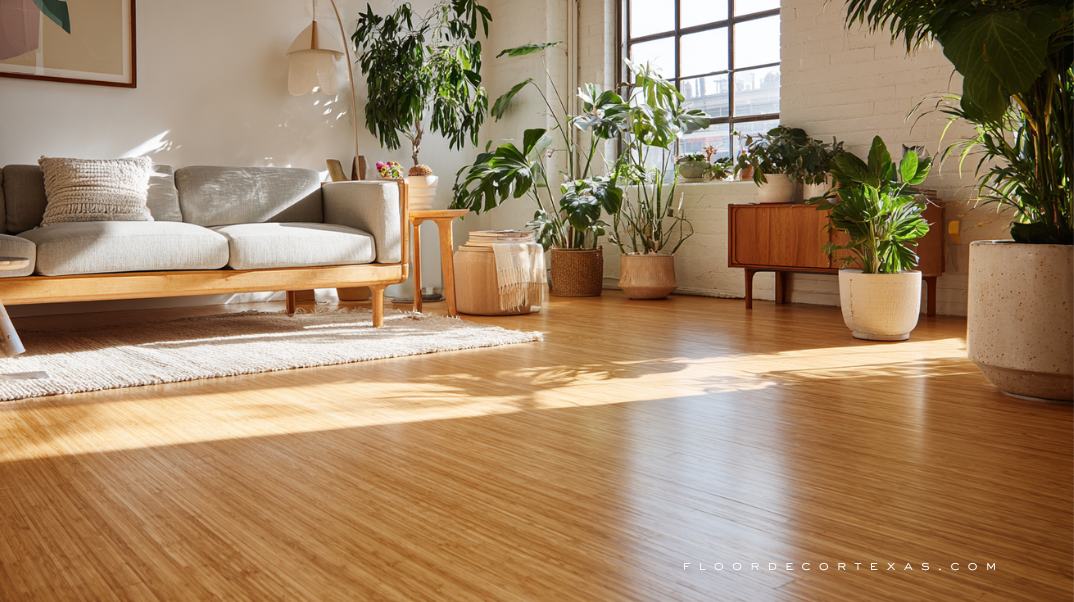
Bamboo is a grass rather than a tree, and some species can grow rapidly after harvesting. This renewability is one reason bamboo frequently appears on lists of sustainable flooring options. Rapid plant growth, however, does not establish the environmental performance of the finished flooring. Harvesting practices, land management, adhesives, factory energy, manufacturing waste, shipping distance, and useful service life all matter.
Bamboo durability and construction
Bamboo flooring may be horizontal, vertical, strand-woven, or engineered. These constructions can have substantially different hardness, dimensional stability, surface finishes, and repair options. Some strand-woven products are very hard, but hardness alone does not measure resistance to scratching, finish wear, moisture damage, or joint failure. Statements that bamboo is always harder than oak are therefore too broad.
Processing bamboo into flooring generally requires cutting, drying, bonding, pressing, machining, and finishing. It is inaccurate to assume that bamboo flooring automatically requires few chemicals. Ask for emissions certification covering the exact product, and determine whether any composite core or adhesive is subject to applicable formaldehyde requirements.
Responsible sourcing should also be documented. If a product carries an FSC claim, confirm the certificate and product scope through the FSC database. FSC has reported integrity risks in portions of the bamboo supply chain, so the presence of environmental language without verifiable documentation should not be treated as proof.
Where bamboo may work well
A suitable bamboo product can work in conditioned living rooms, bedrooms, offices, and dining spaces. Confirm moisture limits, subfloor requirements, direct-sunlight guidance, installation method, and allowable indoor relative humidity. Use entrance mats, remove abrasive grit, clean spills quickly, and follow the manufacturer’s cleaning instructions.
Cork Sustainable Flooring Options
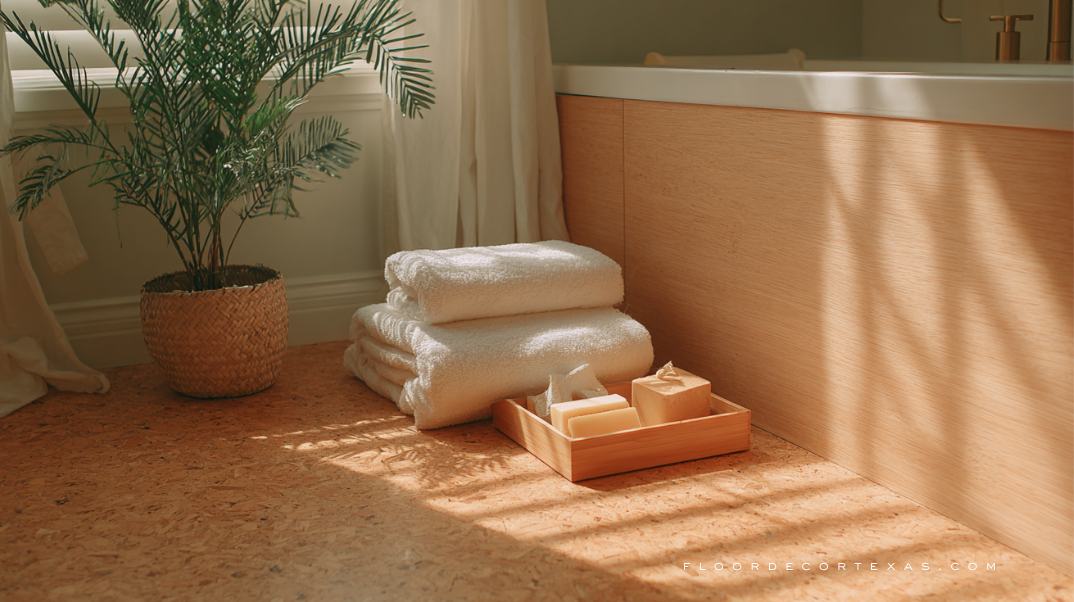
Cork is obtained from the bark of cork oak trees. The bark can be removed without cutting down the tree, after which it regenerates. Harvest intervals are commonly described as approximately nine years, although forestry rules and timing can vary by location and stage of the tree’s life. Responsible forest management remains important because cork landscapes can also provide wildlife habitat and local livelihoods.
Comfort, sound, and product construction
Cork’s cellular structure can make it feel warmer and more forgiving underfoot than hard tile. It may also help reduce some sound transmission and room noise. Exact thermal and acoustic performance depends on product thickness, density, backing, installation assembly, and test method. Request published test data if insulation or sound control is central to the project.
Cork flooring is sold as glue-down tile, finished plank, and engineered floating-floor products. Some floating versions contain a fiberboard core, while others use different backing systems. The sustainability and indoor-emissions profile should therefore be assessed for the complete product, not simply the visible cork layer.
The source image depicts cork in a bathroom, but that should not be interpreted as universal approval for wet rooms. Standing water, failed perimeter seals, plumbing leaks, or moisture beneath a floating assembly can damage some cork products. Use cork in a bathroom only when the exact manufacturer permits it and every installation requirement can be met.
Evaluate the wear finish, core, backing, adhesive, underlayment, and installation system, not only the renewable surface material.
Reclaimed Wood Sustainable Flooring Options
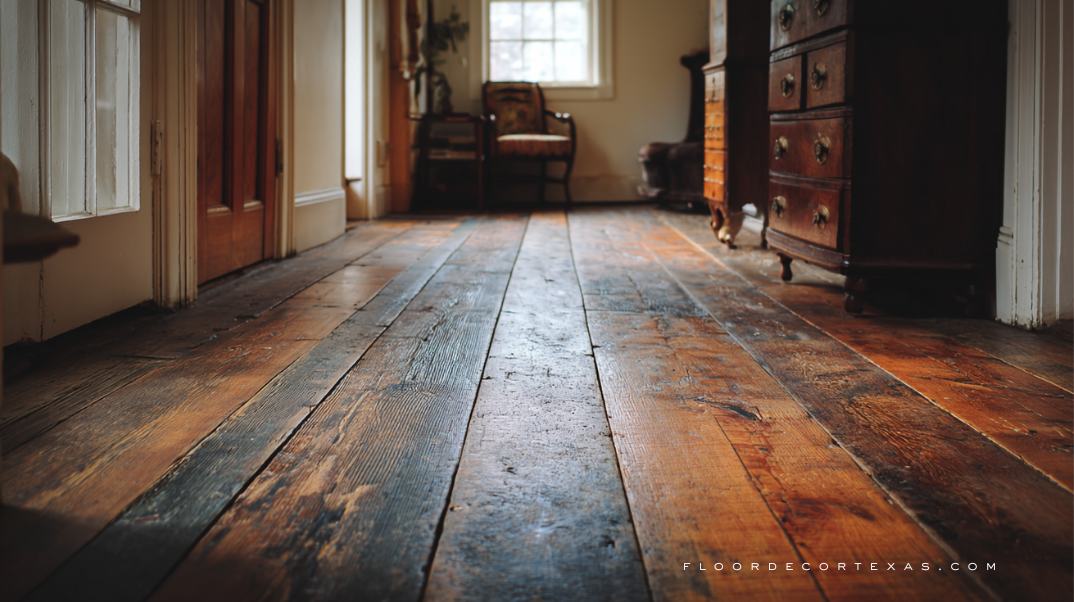
Reclaimed wood flooring reuses material recovered from an earlier application. Sources may include barns, warehouses, factories, houses, industrial structures, or previously installed flooring. Reuse can reduce demand for newly harvested material and divert usable wood from disposal, but the claim should be supported by reliable sourcing records.
What reclaimed wood buyers should verify
Not every reclaimed board comes from old-growth timber, and reclaimed wood is not automatically denser or more durable than new wood. Species, growth conditions, prior use, remaining thickness, fastener damage, moisture history, milling accuracy, insects, decay, and finish condition all affect performance. Ask the supplier to identify the species and source when possible.
Material recovered from older structures may carry paint, preservatives, oils, adhesives, or other residues. A qualified supplier should inspect and process the wood appropriately. Painted reclaimed material deserves particular caution because some older coatings can contain lead. Do not sand or disturb an unknown coating without proper evaluation.
Reclaimed flooring may require de-nailing, kiln treatment, drying, grading, remilling, filling, and finishing. These steps consume resources, yet they can convert irregular material into a functional floor with a long additional service life. Calculate the available quantity carefully because matching replacement boards may be difficult to obtain later.
Pro Tip
Ask for the exact product’s sourcing records, emissions documentation, installation instructions, and warranty before comparing environmental claims. A material can sound sustainable while still being unsuitable for the room, which may lead to premature replacement.
Editorial Team
Compare sustainable floors for your space
Review samples alongside the room’s traffic, moisture, sunlight, maintenance needs, and existing subfloor.
Sustainable Flooring Options Environmental Comparison
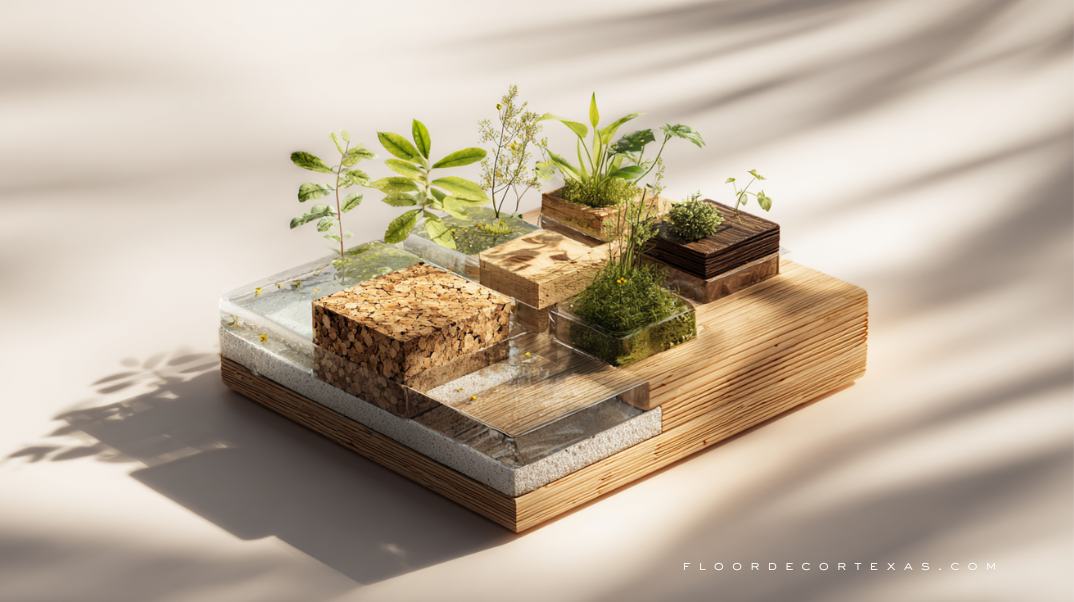
Assigning simple low, medium, or high carbon labels without product-specific life-cycle data can be misleading. The environmental result may change with the factory, energy source, transportation distance, product construction, expected service life, and replacement frequency. An Environmental Product Declaration can provide standardized life-cycle information, but an EPD is a disclosure document rather than an automatic declaration that one product is environmentally superior.
| Material | Potential Advantage | Documentation to Request | Important Caution |
|---|---|---|---|
| Bamboo | Rapidly renewable raw material | Sourcing, VOC testing, construction, EPD | Processing and durability vary |
| Cork | Regenerating bark and comfortable surface | Forest source, core, finish, emissions | Wet-area approval is product-specific |
| Reclaimed wood | Reuses existing forest material | Origin, species, condition, treatment history | Contamination and supply can vary |
Stone and tile may also deserve consideration when longevity is the primary goal. Their environmental impacts differ from plant-based materials, but a long service life and minimal replacement can influence the full assessment. Compare practical performance as well as appearance using this guide to granite and marble flooring.
Sustainable Flooring Options Buying and Installation Guide
Begin with the room’s performance requirements. A floor that fails because it was installed in an unsuitable location creates waste regardless of how renewable its raw material was. Document moisture exposure, traffic, pets, direct sunlight, expected cleaning, desired comfort, and the condition of the subfloor.
Review indoor-emissions documentation
A sustainable floor is not automatically a low-emitting floor. Composite cores, factory finishes, adhesives, sealants, and maintenance products may contribute emissions. The EPA notes that pressed-wood products and some adhesives can be sources of formaldehyde or other volatile organic compounds. Request recognized third-party emissions certification for applicable products and use compatible low-emitting installation materials.
Plan for maintenance and repair
Ask whether the floor can be spot repaired, recoated, refinished, or partially replaced. Keep extra material from the original production lot where appropriate. Use entrance mats to capture grit, felt pads beneath furniture, and manufacturer-approved cleaning products. Preventive care can extend service life without relying on unsupported promises that a material will last indefinitely.
Compare the completed project cost
Include removal, disposal, delivery, acclimation, moisture testing, subfloor repair, underlayment, adhesive, trim, transitions, labor, and future maintenance. Choosing a durable option within budget is often more useful than buying a premium environmental label while overlooking installation quality.
Design longevity also matters. A floor that works with multiple decorating styles may be less likely to be replaced solely because trends change. For adaptable design ideas, see these timeless tile patterns.

Sustainable Flooring Options Frequently Asked Questions
Is bamboo flooring always sustainable?
No. Bamboo grows rapidly, but finished-floor sustainability depends on land management, sourcing, processing, adhesives, energy, transportation, durability, and end-of-life options. Look for verifiable sourcing and product-specific emissions or environmental documentation.
Can cork flooring be installed in a bathroom?
Only when the exact manufacturer approves bathroom installation and all sealing, adhesive, perimeter, and maintenance requirements are followed. Cork products have different cores and moisture limitations. A bathroom photograph does not establish product suitability.
Is reclaimed wood more durable than new wood?
Not necessarily. Durability depends on species, grade, remaining thickness, previous use, moisture history, milling, finish, and installation. Some reclaimed material is exceptionally durable, while other boards may have damage or limited remaining service life.
Do sustainable floors automatically improve indoor air quality?
No. Indoor air quality depends on the complete flooring assembly, including cores, finishes, adhesives, underlayment, sealants, and cleaning products. Check the exact product for recognized emissions testing instead of relying on general natural or green claims.
What is an Environmental Product Declaration?
An Environmental Product Declaration reports standardized life-cycle information using applicable product-category rules. It improves transparency but does not automatically mean the product is environmentally preferable. Compare declarations with similar scope and assumptions.
Which sustainable flooring option is best for a Texas home?
The answer depends on the room, slab or subfloor, humidity control, moisture exposure, sunlight, traffic, pets, and maintenance preferences. Compare documented products within bamboo, cork, reclaimed wood, tile, and other durable categories before deciding.
Choose a floor that supports your home and priorities
Floor Decor Texas can help you compare design, performance, installation, and documented environmental attributes before selecting a floor.
